
At the scene right now? 10 immediate steps
- Stop and Stay: If it is safe to do so, keep the vehicles where they are for a few minutes.
- Call 911: Check everyone for injuries and request emergency personnel.
- Take Pictures First: If it is safe to do so, photograph the vehicles and the scene as they are after the crash and try to capture all damage, skid marks, debris, and traffic signals before moving the vehicles.
- Move Out of Traffic: Once photos are taken and if it is safe to do so, move the vehicles out of the way of other traffic.
- Listen, Don't Apologize: Note what others say, do not admit fault, and do not secretly record audio.
- Identify Witnesses: Get names, phone numbers, and contact info for all witnesses before they leave.
- Report Every Injury: Tell the responding officer about all pain or symptoms, no matter how minor they seem.
- Decide on Medical Care: Use the "Four Bs" (Brain, Breathing, Bleeding, Broken) to evaluate ambulance transport to the hospital vs. taking yourself to urgent care.
- Decide on Your Vehicle: If necessary, decide how you want your vehicle towed and confirm where your car is being towed to avoid surprise rotation-wrecker storage fees.
- Get the Driver Exchange: Make sure the officer gives you the one-page printed Driver Information Exchange form before leaving the scene.
Now let’s take a deeper dive. No one plans to be in an accident. If we did, we’d have to rename them. Unfortunately, however, accidents are a part of life. Whether in a car or a truck, on a motorcycle or a bicycle, or as a pedestrian, chances are you will be involved in an accident at some point in your life. When this unwelcome intrusion happens to you, you need to know what to expect and what to do because as it is with almost everything in our lives, it’s what you don’t know that will hurt you. The information I provide here is neither legal nor medical advice specific to your unique situation and should never take the place of advice from your own attorney or medical provider, but it is information that may be helpful for you to understand some of the issues that present themselves following a car accident.
In the first installment of this “Scene to Settlement” series, we start at the very beginning, the scene of the crash. Chances are that if you’re reading this you’ve already been in an accident and you’re no longer at the scene. If so, don’t fret if you didn’t do everything suggested here. That doesn’t mean that you don’t have a viable claim. These are simply suggestions for the best-case scenario of preserving evidence at the scene of an accident. If you haven’t been in an accident yet, prepare yourself for the idea that as soon as an accident occurs, you need to become an investigator and start documenting the scene because evidence starts changing and disappearing immediately. Acting quickly could make all the difference in the outcome of your claim. So, if you find yourself in this situation, you may wish to consider the following:
Stop and stay at the scene
If it is safe to do so, LEAVE THE VEHICLES WHERE THEY ARE for several minutes while you take the next couple steps.
Call 911
While the vehicles are safely stopped, CHECK ALL PARTIES FOR SERIOUS INJURIES and CALL 911.
Take Pictures
While the police and emergency personnel are on the way, and if it is safe to do so, TAKE PICTURES BEFORE THE VEHICLES ARE MOVED. In addition to the vehicles themselves, take pictures of any other visible evidence at the scene such as skid marks, gouges in the pavement, crash debris, etc. You will also want pictures of the scene itself, placing the vehicles in perspective to the roadway/intersection and showing lighting conditions, weather conditions, stop signs, traffic signals, etc. Make sure you do this as safely and quickly as possible. Do not impede traffic any longer than is necessary to capture this evidence.
Where the vehicles end up after an accident is called “final rest”. As much as we wish it were not true, there is a significant percentage of at-fault drivers who will simply lie to law enforcement and/or their insurance company about how the accident occurred. I can’t begin to tell you how many times I end up fighting with the insurance adjuster or defense counsel over an issue that could have been resolved if there were pictures of the vehicles at final rest. Too often, vehicles are immediately moved after the accident and critical evidence revealing who was at fault is lost. Not only are photos of the vehicles at final rest helpful to your attorney and the insurance company, but they can be especially important if an accident reconstruction expert is needed in your case.
Move the vehicles out of traffic
Unless directed otherwise by law enforcement, and assuming that no one is critically injured and that it is safe to do so, you should NOW MOVE THE VEHICLES TO A SAFE LOCATION OUT OF THE ROADWAY WHILE YOU WAIT FOR FIRST RESPONDERS. Find the nearest location that is safe and practical. Keep in mind that in Central Florida, law enforcement response times can vary widely. It is not unusual to wait 45 minutes or more for a trooper to arrive. If there is a nearby gas station or other business where you and others involved can get out of the heat and wait in a safe, air-conditioned space, that is a perfectly reasonable choice. Just make sure you stay relatively close to the scene, exchange contact information with the other driver before you move, and inform law enforcement exactly where to find you. You don’t want emergency personnel responding to the reported location of the crash only to find that you have moved a mile or two down the road.
Pay attention to what people are saying
Listen carefully to what the other driver(s), passenger(s), and/or witness(es) say and MAKE A RECORD OF WHAT OTHERS SAID TO YOU. This especially applies to any admission of fault by another driver. This includes apologies. An apology or similar statement may later be used as evidence that someone accepted responsibility for the accident. These statements may become critical evidence in the weeks, months or even years to come. To be used in court, you must hear the statement yourself, it can’t be told to you by a third party, so listen carefully to what others say. On the flipside, do not apologize for an accident you did not cause. As stated above, the other side may use your statement to blame you for the accident.
Warning: Given the technology available on our smartphones, you may be tempted to make an audio recording of these conversations. Do not secretly record conversations at the scene. Florida law generally requires consent from all parties to record a conversation thought to be private. If you want to record, first make sure every person being recorded knows about it and agrees to it ON THE RECORDING. When in doubt, do not record and instead simply write down what was said to you as soon as you safely can.
Don’T Forget The Witnesses
MAKE AN ATTEMPT TO GET THE NAME, PHONE NUMBER, EMAIL ADDRESS, AND MAILING ADDRESS FOR EVERY WITNESS AT THE SCENE. Do not presume that law enforcement will get this information. The officer is supposed to document this information, but I have encountered numerous situations where the witnesses never appear on the accident report. Sometimes this happens because the witnesses leave the scene before the officer arrives; other times the witnesses are left off the report because they told law enforcement that they did not want to be involved and the officer obliged; or, sadly, the officer simply chose not to expend the time and energy to collect and add the information to the report. I’ve even seen crash reports where an officer failed to list all the passengers in the vehicles, thus leaving injured parties off the crash report altogether. So, be proactive and gather as much evidence as possible and don’t rely on the officer’s crash report to contain all the information you may need later.
Another point on this that surprises most people is that the crash report is not evidence. Unless the officer happened to witness the crash himself, everything in the report is hearsay that was told to the officer after the crash already occurred. Also, all the statements made to the officer are privileged under the Accident Report Privilege. So, although the crash report is very important and the starting point for almost every case, the crash report does not have the final say on what happened in the accident and who is at fault. The evidence, i.e. the photographs, statements made by the parties to each other, and the recollection of the parties and witnesses of how the accident occurred, is what will ultimately be used to determine what happened and who is at fault for the accident.
Be careful what you say about your injuries
Make sure to TELL THE REPORTING OFFICER ABOUT ANY PAIN OR INJURY YOU MAY BE EXPERIENCING AT THE SCENE, even if you don’t think that they are serious at the time. Typically, when someone is in an accident, there is an element of shock, and the resulting adrenaline prevents most people from immediately feeling the true nature and extent of their injuries. Something that seems slight or minor at the scene may feel debilitating in the days that follow.
Insurance companies often approach cases from the position that an accident victim is faking or embellishing their injuries to get money. Down the road, when trying to negotiate your claim with the insurance company, adjusters will often cite what you said to the officer at the scene or to a company representative in a phone conversation as evidence that you were not really injured in the accident. So, if you feel anything at the scene, make sure to voice it and don’t be quick to dismiss or discount your injuries. Also remember that even if you’re not in pain at the scene, injuries often present themselves in the days following the accident, so don’t be quick to assume that you weren’t injured by the crash just because you don’t have immediate symptoms.
Decide on emergency medical care
Assuming you are not critically injured, you will often be given THE CHOICE WHETHER YOU ARE TRANSPORTED TO A HOSPITAL EMERGENCY ROOM VIA AMBULANCE. This is ultimately a medical decision that only you can make after advice from the emergency medical personnel on the scene. However, you should be aware that an ambulance ride can easily run $1,000 or more, and a single emergency room visit in Pasco County can quickly reach $4,000 to $6,000—or much higher if CT scans or MRIs are ordered. Further, hospital emergency departments are designed to deliver lifesaving treatment, not address non-emergency pain and orthopedic care. As such, once they have established that your injuries are not life-threatening, they will likely discharge you with little to no treatment for the injuries causing you pain and the directive to follow-up as an outpatient with other providers.
You may be thinking that you’re not concerned with the actual cost because you have health insurance, but what you probably don’t know is that your health insurance will usually not be the first to pay your medical bills after a car accident. I will discuss this in much more detail in Part 2 of this series, but a part of your auto insurance called Personal Injury Protection (PIP) becomes primary after a car accident. Valid Florida auto insurance provides PIP benefits after a crash, but important rules and deadlines apply. In many cases, a person must receive qualifying initial medical care within 14 days, and the amount available can depend on the medical findings and the policy. However, for the broader purposes of this article, PIP generally pays 80% of the medical bills related to the accident until it pays out its maximum limit of $10,000.
A $10,000 PIP limit can be used up quickly. The remaining medical bills, and any bills incurred after PIP is exhausted, still must be addressed, especially if the policy includes a deductible. Health insurance can be used when PIP is unavailable or after PIP has exhausted, but the problem is often finding medical providers who will accept health insurance for accident patients. In addition, if and when we recover money from the other side, you will most likely owe the health insurance company back most or all the money they spent on your accident-related care. So, the cost of medical care after an accident becomes the great double-edged sword of auto accident cases. It is often the primary driver of a case’s value, but also the largest expense that must be resolved from the settlement before the client can get their share of any money recovered.
So, returning to your decision at the scene of the accident, if you’re not sure whether you should take an ambulance to the hospital, you may wish to consider what I call the FOUR Bs. If you have a head injury that could involve your BRAIN, if you are having difficulty BREATHING, if you are BLEEDING, or if you may have a BROKEN bone, you should almost certainly be transported via ambulance to the emergency department at the nearest hospital. However, if you are not facing any of these issues, you may be better served by self-reporting to an urgent care facility for examination or making an immediate appointment with a provider who specializes in treating accident patients. I need to be very clear here. The decision whether to be transported to a hospital is a serious medical decision that you must make based on the uniqueness of your situation and what medical personnel on scene are telling you.
Your health comes first. I am not advocating that you take risks with your health.
However, when weighing the decision, keep in mind that emergency transport and ER care can be very expensive, and coverage issues can be complicated. If you are stable and emergency personnel are simply giving you the option of taking the ambulance rather than recommending it, it may be wiser for you to be evaluated by a another appropriate medical provider. Because if you climb into that ambulance and go to the hospital when you don't really need to, you are likely burning through most of your PIP benefits and they’ll be gone forever. That same amount of money could’ve been spent on far more beneficial treatment that would be ongoing, help you heal, and do a better job of documenting your injuries.
Figure out what to do with your car
Once you have collected evidence and addressed your need for medical care, you can turn your attention to your vehicle. IF YOUR CAR IS INOPERABLE, OR YOU’RE GOING TO THE HOSPITAL AND DO NOT HAVE SOMEONE TO DRIVE YOUR VEHICLE HOME, IT WILL NEED TO BE TOWED. If you do not intervene, law enforcement will call a tow truck themselves. We call this the “rotation wrecker”, because law enforcement has a list of providers in the area, and they rotate through them to respond to the scene of accidents.
Some of these wreckers are simply tow truck companies and others are from collision centers or body shops that can not only tow your vehicle but also repair your vehicle once they get it back to their shop. If the rotation wrecker picks up your vehicle, they will take it back to their place of business. Once there, your vehicle will be subject to storage fees for every day it remains at their facility. If you end up not having insurance coverage to pay for or repair the damaged vehicle, the storage fees can rack up and become very costly. The tow truck company does not have to release your vehicle until you pay for both the cost of the tow and any accumulated storage fees. I’ve had clients who waited to hire a lawyer and let their vehicle sit so long that they couldn’t afford to pay the towing and storage fees to get their car back. They had to relinquish ownership of the car to the tow truck company so that it could be auctioned off to satisfy the outstanding charges.
One way that you can avoid this is if you have roadside assistance with towing, such as AAA. You can choose to personally arrange for the vehicle to be towed to a location of your choosing, even to your own home. However, the law enforcement officer will default to calling the wrecker themselves unless you are proactive and communicate with the officer that you want to be the one to arrange for the vehicle to be towed. If you do so and the officer cooperates, this may save you problems in the future. However, be aware that if the vehicle is inoperable and you have the vehicle towed somewhere that can’t repair it, you may need to have it towed again later. And if you live in a deed restricted community, there may be issues with having an inoperable vehicle on your property.
Get your copy of the Driver Information Exchange
In Florida, YOU SHOULD LEAVE THE SCENE OF THE ACCIDENT WITH A ONE-PAGE FORM PRINTED BY THE LAW ENFORCEMENT OFFICER that should contain the names of the primary parties involved, a description of the vehicles and, perhaps most importantly, the insurance information for the vehicles. This will help your attorney start your case before the actual report is available. The full traffic crash report typically isn’t ready for several days or even weeks after the accident, so it is important to have this basic information from the beginning. Below is a sample of what is typically printed by law enforcement and provided to the parties at the scene. As you can see it contains detailed information about the vehicles involved, the owners and drivers of the vehicles, and the insurance companies.
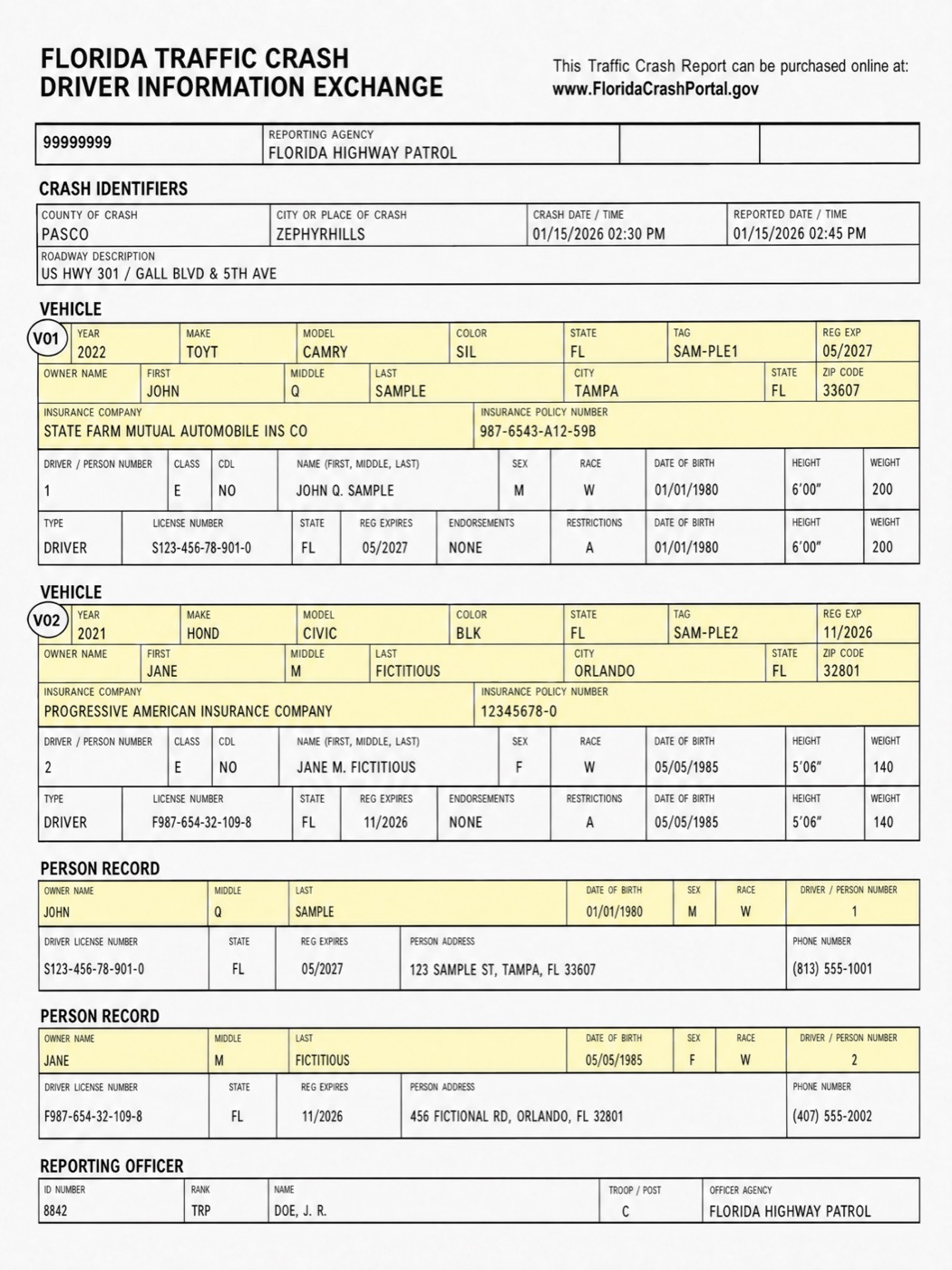
Sample only. This illustration uses fictitious information and is not an actual crash record.
These are the major issues you will deal with at the scene of an accident. The bad news is that the journey of healing from your injuries and recovering your financial losses is a long one. The good news is you don’t have to do it alone. We are here for you. I have over 20 years of experience representing accident victims. At Brewer Law Firm, you’re a name, not a number. Your case will get the personal attention it deserves. The number one complaint I have heard over the course of my career from former clients of other law firms is that the other firm was unresponsive and that the client could never talk to the attorney handling their case. My entire practice is built on the foundation that you will get personal, responsive attention from both my team, and most importantly from me, the actual attorney handling your case. I make myself available to all my clients because I chose to treat my clients the way I hope I would be treated if I were in their shoes. So, if you find yourself the victim of an accident, don’t hesitate to seek help. The sooner you speak with an attorney, the sooner you can understand your options and take the necessary steps to protect yourself and start the process of recovering what you have lost. Call my office at (877) NATE-LAW to schedule a free consultation. REPRESENTATION IS FREE UNLESS YOU WIN. Don’t delay, call today.